


V-OTEC-O-MING 2026 Features Bolden, Party at the Polls with When We All Vote
10/20/2026 in Students
By Lydian Bernhardt / 02/14/2023 College of Agriculture and Environmental Sciences
EAST GREENSBORO, N.C. (Feb. 14, 2023) – The U.S. Department of Agriculture‘s only twice-appointed leader, Secretary Thomas Vilsack, came to North Carolina Agricultural and Technical State University and the University Farm on Wednesday, Feb. 8, to discuss the major investment USDA is making in climate-smart agriculture – and then, to get a first-hand look at those practices in action.
View Our Video: Secretary Vilsack at CAES
“It is a distinct privilege to be here today as we introduce a new day for American agriculture,” Vilsack said. “The climate-smart program will play a pivotal role with producers across the country, and you’re at the center of it. Your projects show that we’re partnered with a great university.”
Vilsack spent the day at the University Farm, moderating a panel discussion with A&T Cooperative Extension faculty and project stakeholders; touring the farm’s USDA-funded climate-smart projects; and on campus, meeting the College of Agriculture and Environmental Sciences’ 26 USDA 1890s Scholars and USDA National Institute of Food and Agriculture Scholars in a roundtable discussion.
Chancellor Harold L. Martin Sr. and Hilda Pinnix-Ragland, chair of the N.C. A&T Board of Trustees, joined farm superintendent Daniel Cooper, USDA liaison Larry Hartsfield and 1890 Scholar Miles Lee in welcoming Vilsack.
“N.C. A&T has long recognized the needs and challenges of minority and underserved communities, who are more likely to live in food deserts and in areas threatened by environmental pollution,” Martin said. “We have a proud history of service to the farming community, and so it is fitting that this discussion takes place right here.”
Vilsack’s visit closely followed this year’s State of the Union address, in which President Biden outlined the country’s investments in a “clean” economy and environmental resilience. USDA, in turn, is investing $2.8 billion on 70 projects in its Partnerships for Climate-Smart Commodities program, an ambitious effort to expand markets for agricultural commodities grown in ways that protect the environment and make economic sense for producers and markets.
Faculty in the College of Agriculture and Environmental Sciences are partnering with USDA on three of those projects:
The projects will help identify social and economic barriers that prevent these farmers from adopting climate-smart practices to help mitigate them, and provide information and technical assistance.
“These projects are going to improve the quality of the soil, which is a critically important, and the quality of the water that we have and the way that we use it,” Vilsack told an audience of USDA stakeholders, commodities groups, small growers and students. “But there’s also a great economic benefit, and that’s what brings us here today. There’s an enormous opportunity for agriculture to redefine the American economy by converting from fossil fuel dependence to a bio-based dependence, and creating more market opportunities for products we grow, and the waste products that are generated from them.”
Local and regional food systems, for example, play an important role in creating local markets that are not controlled by large conglomerates, and where farmers can negotiate good prices and use several different revenue streams to sell crops.
“This creates an entrepreneurial spirit, more farm income, a better environment, lower greenhouse gases, increased carbon sequestration, more jobs in rural places and more opportunities in agriculture,” Vilsack said. “This is a pivotal moment for us, in ag, to say that there’s a different way to approach it.”
Vilsack met regional growers Connie and Millard Locklear of New Ground Farms in Robeson County, Cooperative Extension at A&T’s 2022 Small Farmers of the Year, who raise heirloom and hybrid crops on six acres and collaborate with UNC-Pembroke to teach and test agricultural practices. The Locklears showed the secretary purple sweet potatoes, multicolored carrots and specialty turnips from this year’s crop.
He also got a look at cover crops, pastured dairy cows, community garden and high tunnels, all climate-friendly practices used on the farm.
During a roundtable discussion with students, Vilsack fielded queries about public-sector work, improving the science in mitigating carbon emissions and how to educate skeptics about climate change. He also left the students with an opportunity.
“You are an important lifeline for the American agriculture and the USDA,” Vilsack said. “We’re anxious to make connections with you bright young people. We need you.”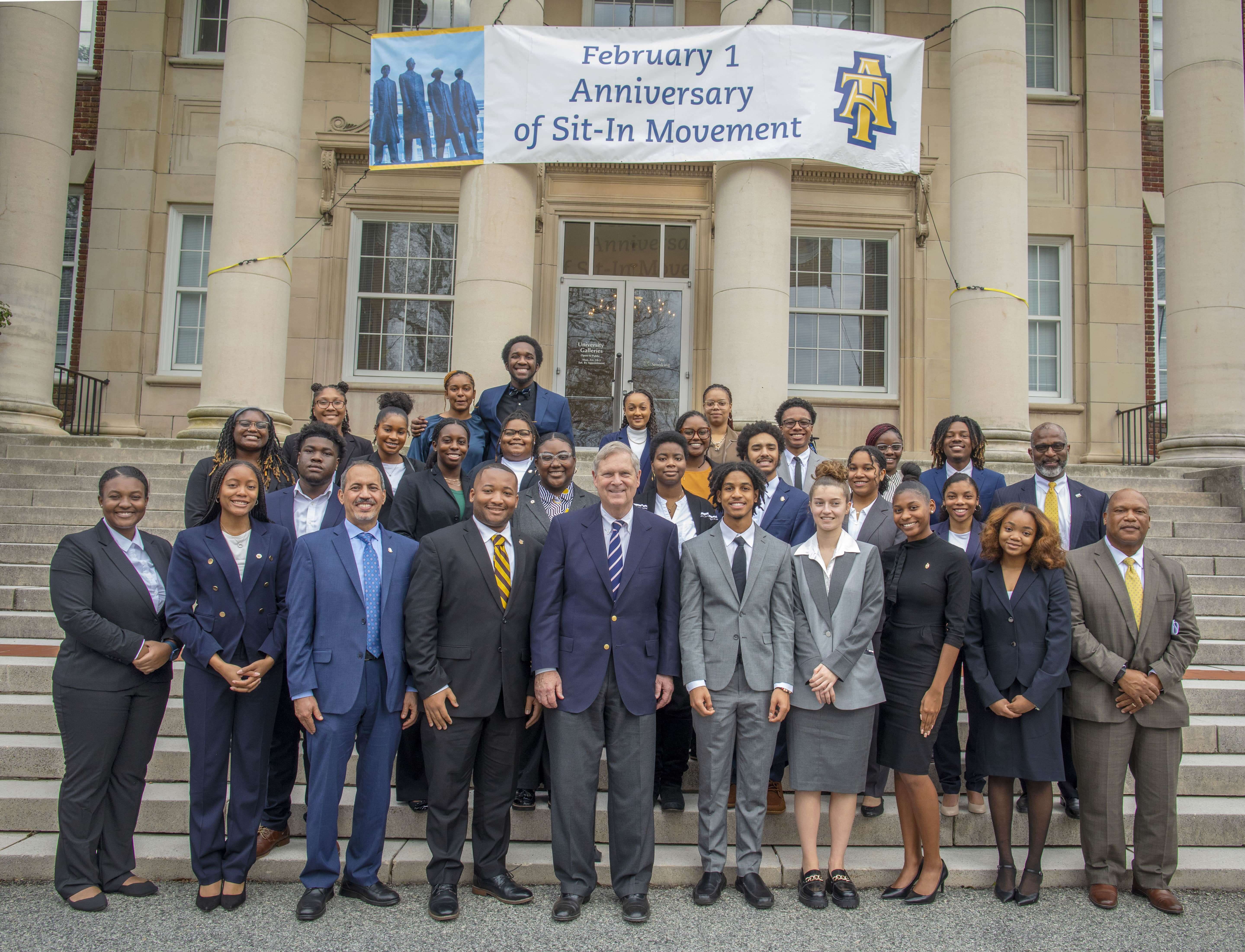
U.S. Department of Agriculture Secretary Tom Vilsack, center, and College of Agriculture and Environmental Sciences Dean Mohamed Ahmedna, third from left, pose with 26 USDA 1890s Scholars and USDA National Institute of Food and Agriculture Scholars.
Media Contact Information: llbernhardt@ncat.edu
